
Introduction
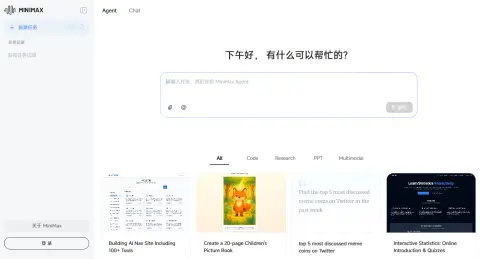
The MiniMax Agent is a general-purpose intelligent entity capable of undertaking long-horizon, complex tasks. It is able to plan expert-level solutions through multiple steps, flexibly break down task requirements, and execute multiple sub-tasks in order to produce the final result.
What is the difference between a chat and an Agent?
AI dialogue chat: It is capable of providing answers to specific questions.
Super intelligent agent Agent: capable of performing a specific task.
Introduction to the MiniMax Agent:
During the development process, the Agent was designed and configured in accordance with the criteria of being “reliable”.
– Programming:
a. It includes more components and more complex routing logic.
b. It is capable of simulating user interactions to conduct extremely comprehensive tests, ensuring that no web pages containing bugs are delivered.
c. Place emphasis on the interactive visual effects and user experience of interface design
Multimodal:
a. In addition to supporting long-text files, it also enables comprehensive analysis of videos, audio files, images, and other types of media.
b. It incorporates built-in capabilities for generating images, audio, and videos, allowing users to create complete works that combine text, images, and sound with just one click.
– MCP expansion
a. Equipped with a built-in MiniMax MCP, offering powerful and cost-effective multi-modal output capabilities
b. Integrate commonly used tools such as Github/Gitlab, Slack, and Figma to enhance context awareness and expand the range of task scenarios in users' daily work and life.
At present, it is not possible to achieve the desired functionality using a single model; therefore, multiple models are utilized at the underlying level, which inevitably results in certain additional costs. We are actively working on developing more efficient solutions that require less computational resources, so that this technology can be more easily used by a wider range of people in their daily lives. “Code is cheap; show me the requirements.” Last month, the International Monetary Fund predicted that between 2025 and 2030, artificial intelligence will contribute to an annual increase in global GDP by approximately 0.5%.
Whether it will significantly exceed this estimate in the future remains to be seen. Let’s wait and watch.
Related