New Mercury
High-speed large language models based on diffusion architectures
Introduction
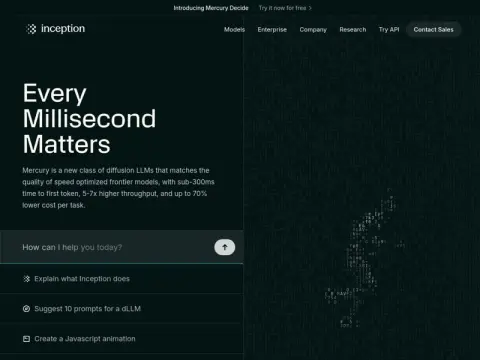
Mercury is a diffusion-based large language model developed by Inception Labs. Unlike autoregressive models like GPT and Claude, which generate tokens one by one, Mercury utilizes the principles of image diffusion to produce multiple tokens simultaneously, which enables it to operate at extremely fast speeds. The latest version is Mercury 3.
According to the official data, the latency of the first token generated is less than 300 milliseconds, and the throughput is 5 to 7 times that of similar speed-optimization models. The cost per task can be reduced by up to 70%, and the quality of the results is on par with that of cutting-edge speed-oriented models. Another advantage of the diffusion framework is that it makes it much easier to ensure that the output conforms to specified format and semantic requirements.
It can be accessed through API calls, and online dialogues are also available for testing. It is particularly suitable for scenarios that are highly sensitive to latency, such as voice assistants, code completion systems, and real-time customer service solutions. For complex tasks that require advanced deep learning algorithms, flagship autoregressive models remain more reliable at present.