
Chat2DB Local
AI-powered database management and visualization tools that allow for operations via natural language.
Introduction
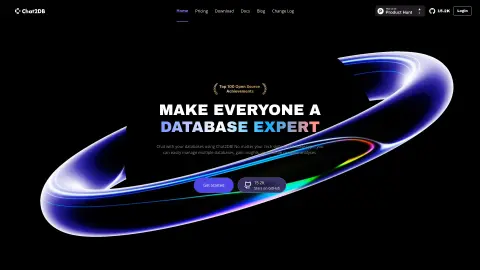
AI-powered database management and visualization tool using natural language.
What is Chat2DB?
Chat2DB is a comprehensive AI-powered database tool designed to assist individuals and teams in managing databases and visualizing data using natural language. It integrates artificial intelligence (AI) and business intelligence (BI) capabilities, enabling database interactions, Excel analysis, the conversion of natural language into SQL queries, and the generation of natural-language reports. It supports a wide range of database systems, including DBMSs, MySQL, Redis, as well as domestic databases such as Dameng and Jincang, in addition to various other tools for database management, visualization, design, development, querying, and connectivity. The local version of Chat2DB also offers a convenient offline mode, allowing for efficient operation in any environment.
How to use Chat2DB?
Users can use Chat2DB to manage various types of databases, generate SQL queries from natural language, optimize and interpret SQL statements, create and edit tables with the help of AI assistants, and generate test data. It also enables interactive data analysis, allows for the creation of zero-code dashboards, and supports importing/exporting data in multiple formats. For team collaboration, users can share SQL scripts and reports, as well as manage team members and their permissions.
The core functions of Chat2DB
AI-driven SQL generation (text to SQL, SQL assistant)
An intelligent SQL editor that offers code completion and error detection features.
AI-powered table creation and test data generation (Table Assistant)
Comprehensive database visualization and management capabilities, including ER diagram creation, as well as data viewing and editing functions.
Import/export of data in multiple formats (CSV, XLSX, XLS, SQL)
Database structure synchronization and data migration
AI-driven conversational data analysis and report generation
Supports over 22 types of relational and non-relational databases.
Robust data security measures (local data storage, end-to-end encryption, SSH tunnels, two-factor authentication, SQL auditing)
Team collaboration features (sharing SQL scripts, reports, and implementing access control)
Open-source projects that use the Apache 2.0 license
Visits:11
Updated:2026-11-07
Related






1
 2
 3
 4
 5
 6
 7
 8
 9
 10

Zlibrary
Zlibrary is known as the world's largest digital library, containing 9,826,996 e-books and 84,837,646 journal articles. From various well-known literary works, science and engineering, humanities and arts, to academic papers, etc.! Support PDF, epu
Sweezy Cursors
Sweezy Cursors is a website that offers a wide range of personalized mouse cursor resources. It features thousands of cursors and pointers with various styles and dynamic effects, covering categories such as anime characters, game weapons, emojis, cartoon animals, technological themes, vector graphics, and popular film and television characters – all designed to suit your needs.
New Orylia AI
AI picture and video generator that remembers your aesthetics
Jina AI
Search for AI providers that offer features such as embedding, reordering, and advanced search capabilities.
The Legacy App
A platform that uses artificial intelligence to capture and preserve family memories and stories.
Conju – Build AI Powered Apps
Through LLM-driven follow-up and integration with CRM systems, Conju converts unanswered calls into sales opportunities.
HeyGen
AI-generated digital human videos
Manifold MCP
An MCP for connecting AI agents to real-time marketing data
LinkFox AI
AI tools designed for cross-border e-commerce
Pica AI
AI art generators are used to create avatars and artistic works based on text and images.
1
2
3
4
 5
 6
 7
 8
 9
 10

Zlibrary
Zlibrary is known as the world's largest digital library, containing 9,826,996 e-books and 84,837,646 journal articles. From various well-known literary works, science and engineering, humanities and arts, to academic papers, etc.! Support PDF, epu
LinkFox AI
AI tools designed for cross-border e-commerce
HeyGen
AI-generated digital human videos
DuiYou AI
Duiyou is a service platform developed by Alibaba Design to support designers throughout their entire career journey. It builds its capabilities around five key user values—quality, efficiency, skills, achievements, and income—to fully serve designers, with the goal of becoming their trusted partner.
Refined through multiple rounds of development by design teams from leading tech companies, Duiyou combines a vast collection of high-quality 3D assets, real-time online rendering, diverse scenario-based applications, a lightweight, easy-to-learn, and user-friendly interface. It also comes with free, commercially usable features, providing professional designers, marketing specialists, students, beginners, and social media influencers with a zero-cost online design platform and resource library.
PixPix
Generation of AI-based e-commerce templates and videos
Riffusion
Generative AI musical instruments enable the creation, remixing, and sharing of high-quality songs based on textual prompts.
OptimizerAI
The AI sound effect generator is capable of generating an unlimited number of high-quality sounds based on text or audio input.
StockTune
StockTune provides AI-generated royalty-free music for content creators to use without attribution.
PDF Converter
Free online tool for converting and editing PDF files.
A Cost-Effective Guide to Living a Better Life: HowToLiveBetter
Which membership services on my phone are automatically deducting fees from my account? Is the password for my main email address the same as that used on other websites? In the rental contract, when exactly will the deposit be refunded? Each of these issues, taken separately, is not particularly complicated. However, without anyone reminding you, it’s very easy to make mistakes. Today, I’d like to share a GitHub repository with 60.5k stars…
1
2
3
4
5
6
7
8
9
10
Zlibrary
Zlibrary is known as the world's largest digital library, containing 9,826,996 e-books and 84,837,646 journal articles. From various well-known literary works, science and engineering, humanities and arts, to academic papers, etc.! Support PDF, epu
LinkFox AI
AI tools designed for cross-border e-commerce
HeyGen
AI-generated digital human videos
DuiYou AI
Duiyou is a service platform developed by Alibaba Design to support designers throughout their entire career journey. It builds its capabilities around five key user values—quality, efficiency, skills, achievements, and income—to fully serve designers, with the goal of becoming their trusted partner.
Refined through multiple rounds of development by design teams from leading tech companies, Duiyou combines a vast collection of high-quality 3D assets, real-time online rendering, diverse scenario-based applications, a lightweight, easy-to-learn, and user-friendly interface. It also comes with free, commercially usable features, providing professional designers, marketing specialists, students, beginners, and social media influencers with a zero-cost online design platform and resource library.
PixPix
Generation of AI-based e-commerce templates and videos
Riffusion
Generative AI musical instruments enable the creation, remixing, and sharing of high-quality songs based on textual prompts.
OptimizerAI
The AI sound effect generator is capable of generating an unlimited number of high-quality sounds based on text or audio input.
StockTune
StockTune provides AI-generated royalty-free music for content creators to use without attribution.
PDF Converter
Free online tool for converting and editing PDF files.
A Cost-Effective Guide to Living a Better Life: HowToLiveBetter
Which membership services on my phone are automatically deducting fees from my account? Is the password for my main email address the same as that used on other websites? In the rental contract, when exactly will the deposit be refunded? Each of these issues, taken separately, is not particularly complicated. However, without anyone reminding you, it’s very easy to make mistakes. Today, I’d like to share a GitHub repository with 60.5k stars…