
Wenyou Xiaozhu
AI Academic Writing Platform
Introduction
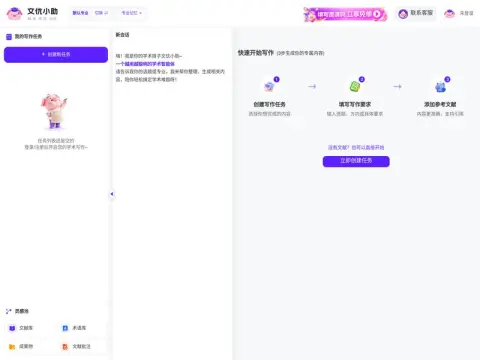
Wenyou Xiaozhu divides academic writing into three steps: creating a writing task, filling in the required information, and adding references. After that, you can submit the task to it for generation. It is possible to start writing without any references, but following its guidance is the recommended approach—especially when references are involved.
The interface is divided into three columns: on the left is a list of writing tasks, in the middle is the dialogue area, and on the right is the guidance process. What truly sets this tool apart from ordinary AI writing tools is the “Inspiration Pool” located in the lower left corner – which consists of four sections: a literature database, a terminology library, a collection of completed works, and notes on referenced documents. The terminology library and the function for adding notes to references are features that are hardly found in general-purpose writing tools; they have been specifically designed to align with the actual processes involved in conducting research.
It labels itself as “precise, efficient, and compliant.” Compliance is certainly a essential requirement in the context of academic papers. However, the official website does not provide specific instructions on how to reduce the word count or how to check the accuracy of AIGC-generated content. Those who wish to use this tool will have to try it out themselves by writing a test paper first.
You need to scan a WeChat code to log in before you can access it. If you are not logged in, the task list will be empty. This tool is ideal for students and researchers who are currently writing reviews or need to manage a large number of references; however, if you simply want to refine a few paragraphs of text, this set of tools might be overkill.