
MiroFish
AI prediction engine based on multi-agent simulation
Introduction
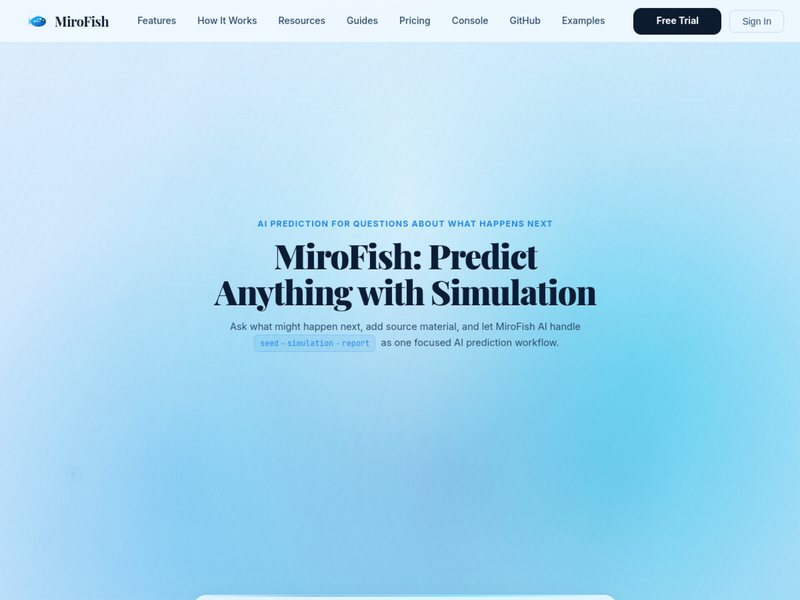
MiroFish is neither a chatbot nor a traditional data prediction tool. The questions it answers are: “If something happens, how will all parties react in response?”
The process consists of several steps: you describe the scenario in natural language and upload relevant materials (TXT, PDF, Markdown are supported). The system extracts information about characters and their relationships from these materials to create a knowledge graph. Based on this graph, it generates a group of intelligent agents with predefined character traits, which are then placed in a simulated environment to interact with each other. Finally, a report containing branching pathways, group dynamics, and a timeline is produced. During the simulation process, variables can be introduced, and individual intelligent agents can also be “interviewed” separately.
Typical applications include analyzing public opinion trends, assessing users’ reactions to price increases of products, conducting policy debates, and determining the implications of changes in brand endorsers. Some people also use it to develop the worldviews of fictional novels.
It should be noted that this simulation focuses on “human behavior and motivations,” and its conclusions rely heavily on the data you provide. Therefore, it is not suitable as a basis for making investment decisions or predicting the outcomes of sports competitions. Instead, it is more useful for identifying reaction patterns that you might not have considered yourself.
The project is open-source on GitHub (licensed under AGPL-3.0 and can be self-hosted using Docker). Visitors of the online version can use the simulation tool for free once; each analysis costs $2, while a subscription plan starts at $9 per month.