Connected Papers
academic tools
Introduction
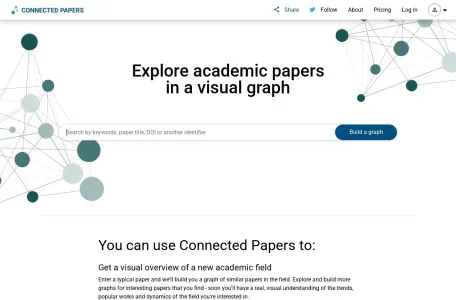
Connected Papers is a visual tool to help researchers and applied scientists find academic papers relevant to their field of work.
Introduction to Connected Papers
Connected Papers is an AI-powered literature search tool specifically designed for academic research. Its purpose is to assist researchers in quickly locating academic papers related to a particular subject, thereby enhancing the efficiency and quality of their work. By constructing a network of paper relationships, this tool enables users to clearly visualize the citation patterns between different documents, allowing them to promptly identify and understand the latest developments in their field of study.
The main functions of Connected Papers
The main functions of Connected Papers include:
Literature search and analysis diagram: Papers are represented by nodes, where the size of each node indicates the number of times it has been cited. The color of the node signifies the year of publication. Densely connected lines illustrate papers that are similar to each other, facilitating researchers in quickly locating and understanding relevant research areas.
2. Previous research: Lists the literature cited in the article, assisting users in tracing the origins and development of the relevant research.
3. Derived works: A list of subsequent articles that are derived from or make use of the current literature is provided, offering users guidance on potential future research directions.
4. Intelligent Recommendation: Based on the keywords entered or the papers selected, relevant research articles are automatically recommended to broaden one’s research scope.
5. Document Management and Export: It allows users to save the found papers to their personal libraries, where they can be organized, tagged, and annotated for easy subsequent reading and citation. Additionally, papers can be exported in PDF format, enabling offline reading and printing.
Features of Connected Papers
The main features of Connected Papers include:
1. Excellent visualization: The provided literature network diagrams are clear and intuitive, allowing users to quickly understand the underlying relationships between different documents in the form of visual representations.
2. Excellent user experience: The operating interface is simple and intuitive, and the navigation guidelines are clear and easy to understand, allowing users to get started quickly and use various functions effortlessly.
3. Supports multiple retrieval methods: Users can construct literature correlation network graphs using keywords, DOI numbers, or titles. The system also provides filtering and sorting functions, enabling users to simplify and optimize these network graphs as needed.
4. Promoting academic exchange and collaboration: The platform facilitates communication and cooperation with other researchers. Users can share research findings, post comments, and raise questions on the platform, thereby enhancing the exchange and collaboration within the academic community.
The target audience for Connected Papers
Connected Papers is suitable for a wide range of academic research scenarios, especially for the following groups of people:
1. Researchers who need to conduct literature reviews or prepare research papers: Connected Papers can help them quickly locate papers that are closely related to their research topics, thereby improving the efficiency and quality of their work.
2. Researchers engaged in new research directions or projects: By using Connected Papers, they can quickly gain an understanding of the history, current state, and development trends in their field, which serves as a guide and inspiration for their subsequent research efforts.
3. Scholars and students interested in specific academic fields: Through Connected Papers, they can easily explore the depth and breadth of a particular field, thereby gaining valuable support for their in-depth research efforts.
Frequently Asked Questions about Using Connected Papers
When using Connected Papers, users may encounter some common issues and problems. Below are some possible solutions:
1. Unable to register or log in: Please check whether your network connection is normal and ensure that the username and password you entered are correct. If the problem persists, please contact customer service for assistance.
2. Inaccurate search results: Please check whether the search keywords you entered are correct, or try using different keywords to conduct your search. Additionally, you may also consider utilizing the advanced search options to obtain more precise results.
3. If the literature network diagram cannot be displayed, please check whether your browser supports the website’s graphic rendering capabilities, or try using a different browser to access the page.
4. Limited number of search attempts: There may be a limit on the number of searches that can be performed using Connected Papers. To address this issue, users may consider paying to become members in order to access additional search quotas, or they could try using other academic databases or tools for supplementary searches.
Overall, Connected Papers is a powerful and user-friendly academic tool that serves as an indispensable assistance for researchers who need to conduct literature searches and analyses.
Related