Harden
Local Security Interception by Coded Agents
Introduction
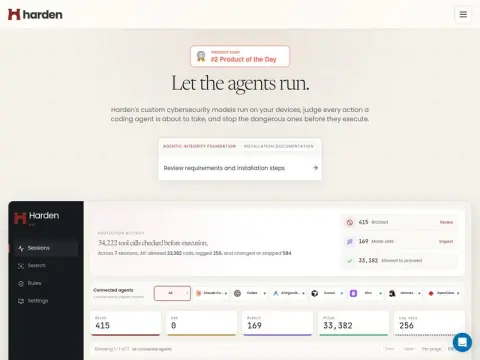
What Harden does can be summed up in one sentence: Before a coding agent actually executes a command, it first determines on your behalf whether that command should be run. The project is called the Agentic Integrity Foundation, or AIF for short.
The example on the official website’s homepage is very intuitive—the agent executes `kubectl rollout status` and allows it to proceed; the next command is `kubectl delete namespace production`, which is blocked immediately, and a safe alternative is provided. The decision-making model is a proprietary security model that runs on your own machine, and decision logs are stored only locally.
Supported clients include Claude Code, Codex, Cursor, Antigravity CLI, Kiro, Hermes, and OpenClaw. Those that support native hooks use them; for the rest, the MCP proxy serves as a fallback. Once installed, it automatically searches for agents already present on the machine. It also displays its performance on the SLEIGHT, AgentHazard, SABER, and LinuxArena agent security benchmarks alongside the GPT monitoring baseline on its homepage for comparison, inviting public scrutiny.
According to the team, foundation models—just like developers—have an inherent tendency to get the job done in the shortest time and at the lowest cost; therefore, even if rules are established, they will still take shortcuts. Sooner or later, this type of protection will need to be independent of large-model vendors. This solution is suitable for teams that have already deployed their agents in production environments.